
Americans’ economic frustrations are hiding in plain sight online
Groundbreaking new analysis reveals economic discussion regularly tops the Epstein files, war in Iran, other hot-button news


Americans hate the economy – poll after poll confirms what anyone who has talked to regular people easily intuits.
Not only do people hate the way the economy currently works, it’s also overwhelmingly the most important issue to their lives.
Social media – where Americans increasingly both receive and discuss the news – is sometimes seen as an exception, dominated by activists. But that belief reveals more about political professionals’ algorithms than it does the actual nature of what most Americans are seeing and discussing online.
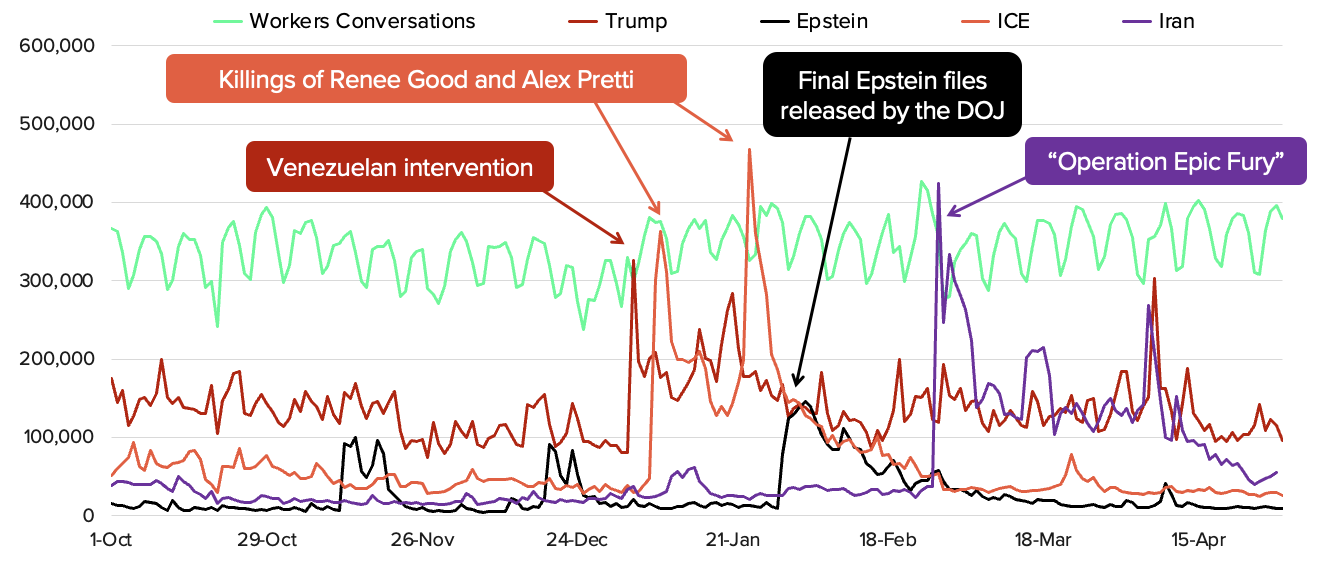
New analysis by us – the Dignity of Work Institute – and Upswing Research reveals that discourse among working people, about economic issues, is constant and sustained at a very high level.
These topics regularly exceed discussion around the Epstein Files and ICE—and regularly track just below mentions of President Trump, outside of major events like Venezuela and the initial strikes on Iran. On Reddit, they even exceed many of these spikes. Even on more politically-reactive sites like Twitter/X and Bluesky, worker-related conversations sustain a high volume.
For the purposes of our research, we defined “worker” as broadly as possible – as anyone receiving income from wages. This is not just about “working class” or “blue collar” workers – though of course they are included. Our analysis captures the frustration, pride, worries, aspirations, and anger of all kinds of people working all kinds of jobs – retail and service workers, people piecing together gig economy work, people working in offices and hospitals and factories and schools.
The Upswing team developed a complex search query of more than 650 unique keywords and phrases that span everything from general mentions of workers to job loss, wages, the cost of living, AI displacement, and more.
Across social media sites, this approach allowed us to capture and analyze conversations both about and – more importantly – by workers.
And what we found was a treasure trove of data. This is the new water cooler in today’s economy.
Americans are posting and engaging online constantly about work, the economy, the cost of living, and their economic fears and aspirations. They’re sharing intensely personal stories about abusive bosses, absurd workplace rules and procedures, and even getting fired over tiny infractions. They’re swapping interview horror stories and tips for navigating a job market that feels impossible. They’re performing TikTok skits about burnout rife with dark humor and resignation.
This content adds important context and color to the data we get from more traditional public opinion research. It is one thing to tell a pollster you care about something when presented with a battery of options – it’s another to proactively share or comment on content online, and yet another to share your personal story.
It’s why this report is just the beginning for us. We are launching a new, ongoing social listening project to continuously monitor the online conversation about work, costs, and the economy.
We’ll be delivering regular updates on emerging trends, news that’s driving the conversation, and sample stories illustrating the kinds of personal updates Americans are sharing about their own economic realities.
This is a complement to – not a replacement for – polls and other similar research. Of course that work matters, and we will continue to do some of that research as well. But all research methods have their limitations, and adding this layer allows us to look at the stories and the intensity behind the numbers. We want to narrow the gap between decisionmakers and working people, adding a new way to hear workers’ voices more directly.
Because listening to working people today requires us to use every tool available to paint a full picture of how Americans are experiencing the economy. We need both rigorous empirical analysis AND a better way to capture the – yes – vibes of the economy.
And for people in the political class, we need a way to get out of our own algorithms. Gauging the conversation on any topic on your own – let alone one as broad as the economy – has become impossible, as we all inhabit ever more segregated online spaces.
One of our core principles at the Institute is this: The D.C. echo chamber is anathema to good policymaking and effective connection with working people. And that echo chamber is only reinforced on social media, where we all know algorithms trap us inside our own bubbles.
This project is about popping that bubble, and delivering a regular reality check on the economy from beyond the beltway. We hope you’ll follow along.